

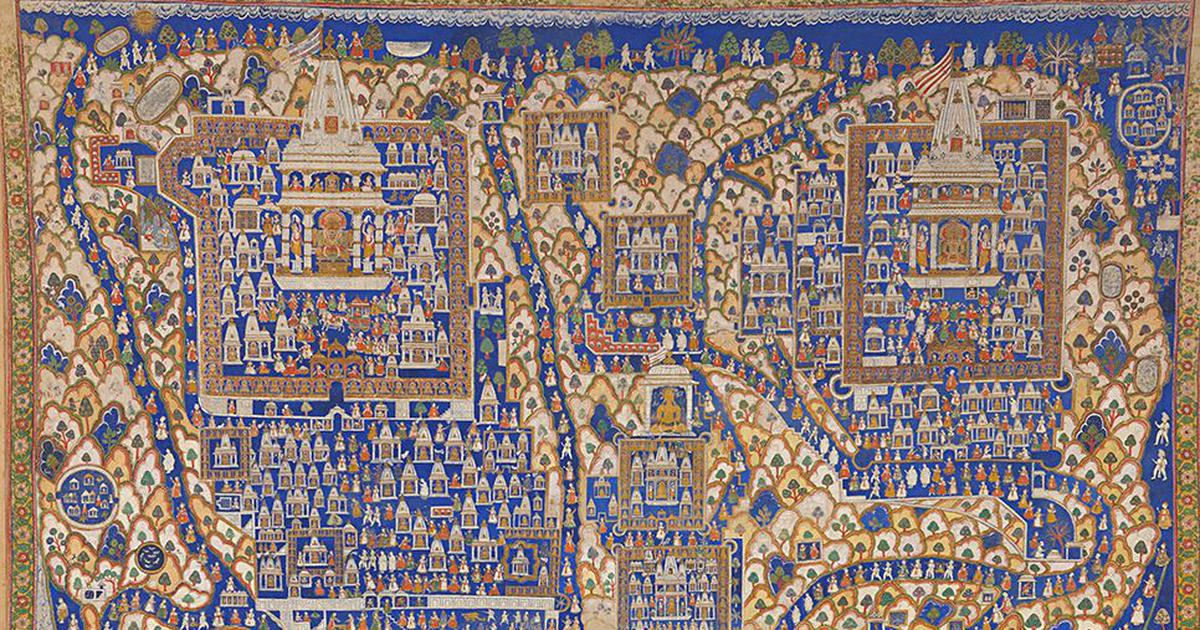
The ideas behind early Indian cosmographies often predated the invention of print. These were not maps of physical terrain but of inner worlds – depictions of the soul, the cosmos, and moral order. Dense with meaning and rich in iconography, they demand time, reflection, and interpretation. Their presence reminds us that the desire to map existed not only to understand where we are – but who we are. Long before printed maps, there was a human instinct to situate ourselves in a world both real and imagined. These maps compressed worldviews, philosophies, and cultural cosmologies into an intricately illustrated form. It’s easy to get lost in their many layers – depictions of heaven and hell, the cycles of rebirth, or diagrams of the human journey through time and space. They remind us that the origins of mapping lie not only in the desire to chart coastlines or claim territory, but also in the deep human impulse to understand one’s place in the cosmos.
In the East, this knowledge was often passed down orally or preserved in manuscripts written in regional scripts – later to be illustrated as the cosmographies seen in this book. In the West, the tradition took form in the mappa mundi that blended...
from Scroll.in https://scroll.in/article/1090306/a-new-book-examines-why-ancient-maps-are-still-a-source-of-wonder-even-in-the-age-of-gps?utm_source=rss&utm_medium=public https://sc0.blr1.cdn.digitaloceanspaces.com/article/211681-fokdobwwdh-1769559891.jpg
via



0 Comments