

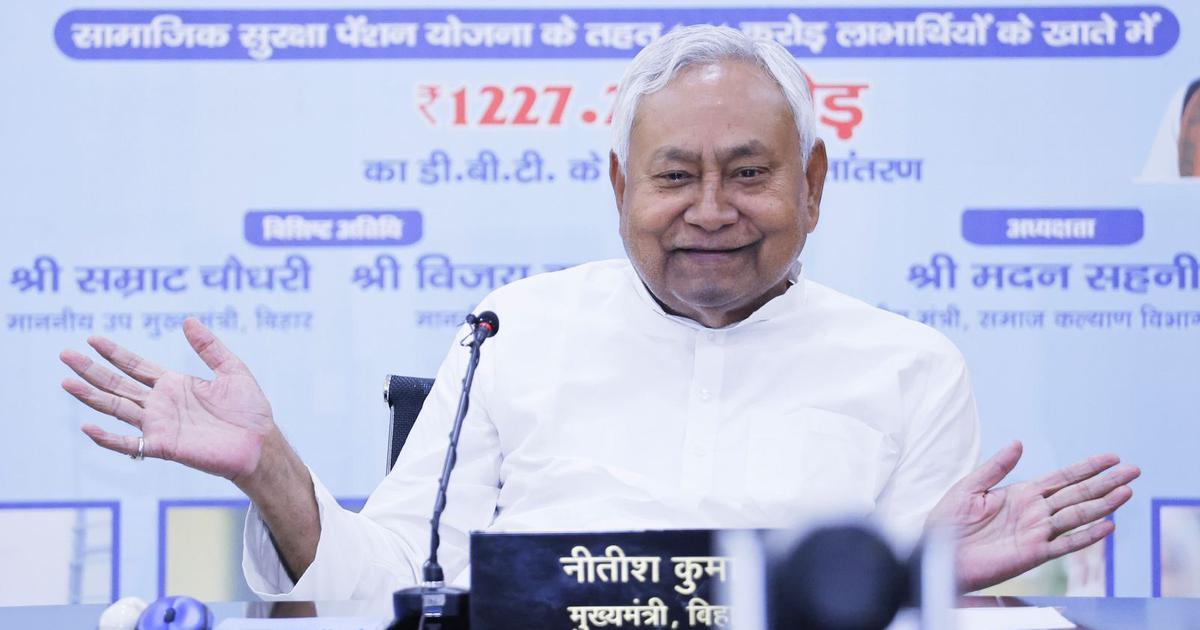
Political eras often fade quietly rather than end with a dramatic rupture. Bihar now appears to be approaching such a moment. After nearly two decades at the centre of the state’s political life, Chief Minister Nitish Kumar’s exit from the stage seems both surprising and inevitable: surprising because of the durability and adaptability that have long defined his career, yet expected because the political architecture he built has gradually evolved beyond the personal authority that sustained it.
The question confronting Bihar, therefore, extends beyond succession. It concerns the fate of a distinctive political experiment – the attempt to reconcile the moral promise of social justice with the practical demands of development and social peace.
Few leaders in contemporary India have embodied democratic pragmatism as fully as Nitish Kumar. Emerging from the socialist ferment of the 1970s, he belongs to the generation shaped by Jayaprakash Narayan’s call for “Total Revolution”, a movement that challenged the dominance of the Congress system and sought to democratise power across Indian society.
This upheaval eventually matured into the Mandal moment of the 1990s, when politics across North India reorganised itself around the language of social justice and caste representation.
Nitish Kumar emerged from this same ideological lineage, yet his political project gradually diverged....
from Scroll.in https://scroll.in/article/1091211/as-nitish-kumar-as-quits-bihar-chief-minister-what-will-happen-to-his-politics-of-social-justice?utm_source=rss&utm_medium=public https://sc0.blr1.cdn.digitaloceanspaces.com/article/208326-qswvsbveib-1752592044.jpg
via



0 Comments