

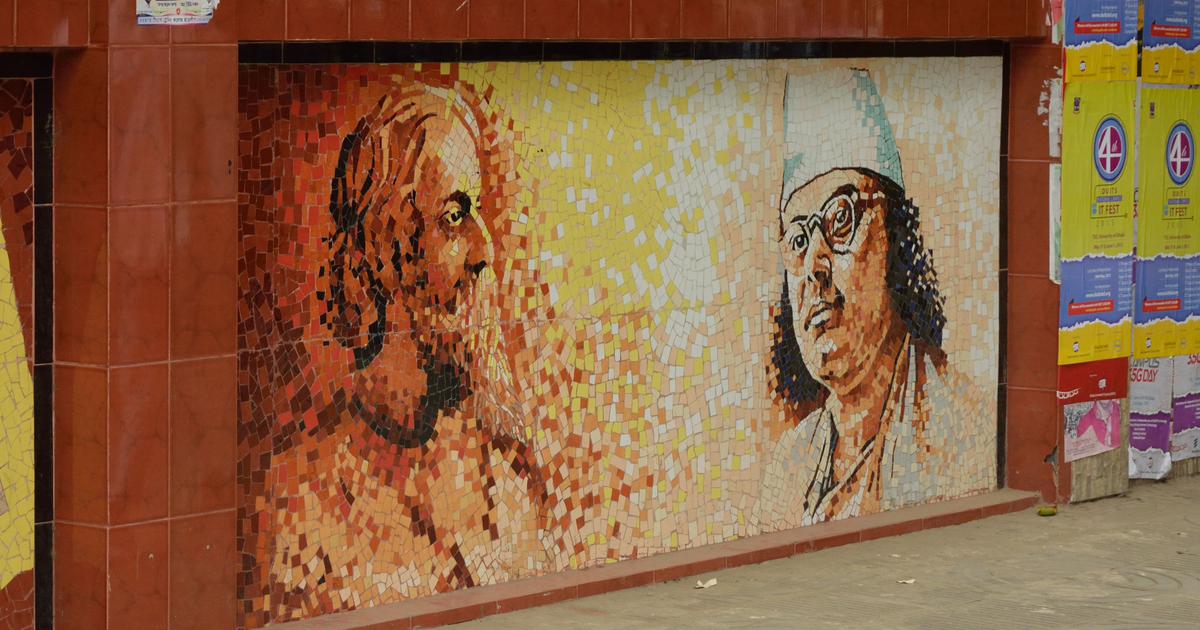
On a Saturday afternoon in Dhaka, a group of young people decided that Rabindranath Tagore needed to be erased. They arrived outside the Bangladesh Shilpakala Academy in Segunbagicha, where a newly painted mural displayed the faces of Bengali cultural figures. One of them, a young woman, began smearing black ink across Tagore’s portrait.
The police intervened and four people were detained, including ANM Ayas, a 29-year-old activist associated with the Rashtra Sanglap Forum who had recently attracted attention on social media through a series of provocative public antics.
Their act of cultural vandalism soon became a criminal case. A Dhaka court placed all four on remand on October 11, with allegations involving criminal conspiracy, inciting enmity between groups and religious hatred.
One woman reportedly explained the group’s motive as opposition to Indian aggression. Tagore, in this formulation, was not a poet born in Bengal decades before Partition. He was an Indian symbol to be removed from a Bangladeshi wall.
The argument was historically impoverished. The reaction to it was more revealing.
Later, the cultural organisation Udichi assembled musicians, singers and activists on the pavement beneath the murals. A man in a blue checked shirt played a harmonium resting on a plastic stool. A woman in a green sari sang into...
from Scroll.in https://scroll.in/article/1096376/in-bangladesh-rabindranath-tagore-has-become-a-fractured-inheritance?utm_source=rss&utm_medium=public https://sc0.blr1.cdn.digitaloceanspaces.com/article/216079-mhueceheqf-1791913678.jpg
via



0 Comments